---
title: "The Four Horsemen of the Relational Apocalypse Part 2: Contempt, and How to Stop It Biblically"
description: How to stop contempt in your marriage the biblical way. Dr John and Julie Gottman tell us contempt indicates future divorce.
image: https://www.marybethwimmer.com/hubfs/4%20horsemen%20contempt.png
---
[Skip to content](https://www.marybethwimmer.com/blog/the-four-horsemen-of-the-relational-apocalypse-part-2-contempt-and-how-to-stop-it-biblically#main-content)
[](http://God's%20Rx)
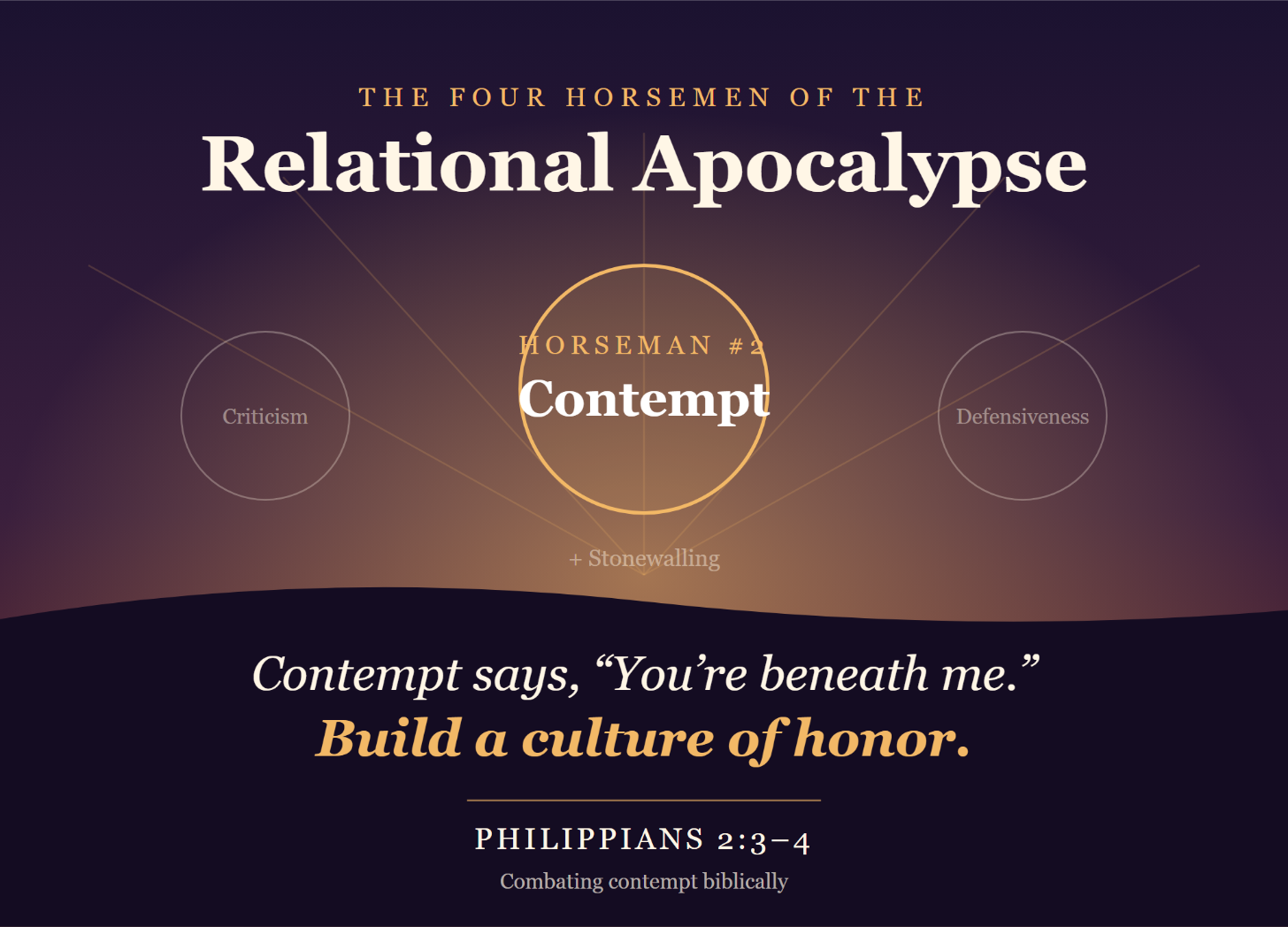
# The Four Horsemen of the Relational Apocalypse Part 2: Contempt, and How to Stop It Biblically

[MaryBeth Wimmer November 11, 2026](https://www.marybethwimmer.com/blog/author/marybeth-wimmer)
- [Growth](https://www.marybethwimmer.com/blog/tag/growth)
- [mind renewal](https://www.marybethwimmer.com/blog/tag/mind-renewal)
- [Emotional health](https://www.marybethwimmer.com/blog/tag/emotional-health)
- [Relationships](https://www.marybethwimmer.com/blog/tag/relationships)
- [kindness](https://www.marybethwimmer.com/blog/tag/kindness)
- 9 mins
Last time we looked at criticism, the first of the four patterns Drs. John and Julie Gottman found to predict divorce. Today we meet the second rider, and the Gottmans consider it the most destructive of all: **contempt**.
Criticism says, “You did something wrong.” Contempt says, “You are something wrong. You are less than me.” It attacks a person’s sense of self with the intent to insult, belittle, or wound. Where criticism condemns a behavior, contempt condemns the person.
### ***The many faces of contempt***
*Contempt does not always shout. Some of its forms are loud, but many are quiet:*
- ***Mockery and mimicry:** imitating your spouse’s voice, mannerisms, or words in order to make fun of them or belittle them.*
- ***Sarcasm:** “Oh, brilliant idea. You really have a gift for this.”*
- ***Name-calling:** “idiot,” “useless,” “you’re just like your mother”*
- ***Eye-rolling and sneering:** the look that says, “I can’t believe I married you”*
- ***Hostile humor:** put-downs disguised as jokes, followed by “I was only kidding” or laughing*
- ***Cold disdain:** the silent treatment that carries the message, “You are not worth my attention”*
*There is also the insidious form no one else ever hears: the contempt we speak silently inside. “You stupid idiot.” “What is wrong with her?” We may never say it aloud, but the thought still shapes our tone, our expression, and the way we treat the person.*
The Bible has a rich vocabulary for it. The Hebrew word buz means contempt or derision, an attitude that belittles its object and sets the speaker above it. Its root, bazah, means “to despise.” Jesus took it seriously enough to say that the person who calls his brother “Raca” or “You fool” stands in real danger before God (Matthew 5:22).
### **Where contempt comes from**
Contempt rarely appears out of nowhere. It grows from roots, and the roots are worth examining.
**Pride.** Luke 18:9 describes people who trusted in their own righteousness and treated others with contempt. Pride in ourselves, our faith, or our abilities lifts us above other people and lowers them in our estimation. Contempt and self-righteousness grow from the same root.
**A hurt heart’s shield.** When we feel criticized, belittled, or unseen, it is natural to protect ourselves by belittling the other person in our mind. If they are foolish, their opinion can’t hurt us. Moses shows how this works. After years of leading people who complained constantly, he snapped, “Listen, you rebels, must we bring you water out of this rock?” (Numbers 20:10). He had wrath but no compassion, and it cost him. The sign of a heart protecting itself is words of denunciation with no humility or tenderness.
**Resentment left to grow.** Proverbs 18:3 says that when the wicked comes, contempt comes too. Contempt is anger’s cold sibling. Small hurts that were never spoken, never brought to God, and never resolved harden over time into disdain.
**Patterns we learned.** In Part 1 we asked which caregiver we most wanted something from. We can also ask who taught us how to treat people when we’re frustrated. Many of us grew up in homes where mockery counted as humor and put-downs passed for communication. The problem is that our emotions follow our thoughts and words. Humor that belittles breeds emotional distance, and love fades as contempt grows.
### **How contempt hurts a marriage**
Contempt treats a fellow human being as worthless or “less than.” That clashes directly with the command to love our neighbor as ourselves. Contempt toward our spouse often has a twin: the contempt we direct at ourselves. We’ll come back to that below.
- **It insults the Maker.** “Whoever oppresses the poor shows contempt for their Maker” (Proverbs 14:31). When we show contempt for a person made in God’s image, we show contempt for the One who made them.
- **It puts us in the wrong seat.** “Why do you despise your brother? For we will all stand before the judgment seat of God” (Romans 14:10). Contempt is judgment with a shake of the head or a roll of the eyes, and the judgment seat is not ours.
- **It misses what God is building.** “Who has despised the day of small things?” asked Zechariah (4:10). The builders looked at a modest beginning and sneered, but God rejoiced over it. When we look at our spouse’s weaknesses with disdain, we overlook what God is working into them.
Which brings us to a question worth sitting with: shouldn’t our covenant promise in marriage triumph over scorn, derision, and contempt?
> **A note on the seriousness of contempt**
>
> Contempt is not simply a communication problem. It is a serious wound, and when it is paired with fear, control, or any form of physical harm, it is abuse. Physical and emotional abuse have no place in a marriage, and they are never the fault of the person receiving them. A spouse who blames you for their behavior is not practicing the love Scripture describes.
>
> This article is a mirror for examining your own heart. It is not a tool for diagnosing, excusing, or enduring someone else’s mistreatment. If you are being hurt, or you are afraid of your spouse, please reach out to a trusted pastor, a counselor, or the National Domestic Violence Hotline (1-800-799-7233 in the US, or text START to 88788) or your local domestic violence service before attempting any of the conversations in this series.
### **The biblical remedy: Romans 2:4**
> “Or do you show contempt for the riches of his kindness, forbearance and patience, not realizing that God’s kindness is intended to lead you to repentance?” (NIV)
Paul’s answer to contempt is not more willpower, a sharper rebuke, or a better argument. It is **kindness**. Kindness is what God used on us, and it is what leads to change. Let’s walk through how to put it into practice.
**1. Look in the mirror**
James 1:23-25 compares God’s Word to a mirror. The man who looks and walks away forgets what he saw. The man who looks and keeps looking is blessed in what he does. The first step is to look at yourself. Where do I hear contempt in my own thoughts? When do I roll my eyes, sigh, or reach for sarcasm? Contempt starts as a thought before it becomes a tone, so catch it there. Jesus reminds us that we will give an account for every careless word we speak (Matthew 12:36).
**2. Remember the kindness you received**
Contempt forgets grace. When we are tempted to look down on our spouse, we should remember that we all began with nothing except what God placed in us, and that at any moment God can raise someone up or bring them down. He met our failures with kindness, not scorn. “Humility added to faith” keeps us from despising others, and it echoes Philippians 2:3, “in humility count others more significant than yourselves.”
Perhaps you treat yourself with contempt, too. That needs to stop as well. Scripture describes God’s treatment of us as kind and patient, and we cannot offer our spouse a kindness we refuse to extend to ourselves. Loving others well often begins with loving ourselves well, which means no longer hiding behind a wall of foolish thoughts and words.
**3. Stay connected to the vine**
Galatians 5:22-23 lists the fruit of the Spirit as a single package of nine attributes: love, joy, peace, patience, kindness, goodness, faithfulness, gentleness, and self-control. Notice that the Spirit produces this fruit, not us. “I am the vine; you are the branches... apart from me you can do nothing” (John 15:5). If we are producing contempt, it is a sign that we have disconnected from the source. The remedy is not to try harder but to reconnect. Pray first, as we learned in Part 1, and let the Spirit grow what we cannot.
**4. Choose honoring speech**
Ephesians 4:29 tells us to let no unwholesome talk come out of our mouths, but only what is helpful for building others up. The Gottmans’ own antidote to contempt agrees: build a culture of appreciation and respect. Compare these two responses to the same moment:
> “Oh, great, you forgot again. Brilliant. I don’t know why I even bother asking.”
>
> “I know you’ve had a long week, and I appreciate how hard you work for us. When I ask for something and it doesn’t happen, I start to feel unimportant. Could we find a way to help you remember?”
The second response is not weak, and it does not pretend the problem is imaginary. It simply refuses to turn a problem into an insult.
**5. Drive out the mocker within**
Proverbs 22:10 says, “Drive out the mocker, and out goes strife; quarrels and insults are ended.” Many of us read that as a verse about other people. Try reading it as a verse about the mocker inside ourselves. When we drive out the inner voice that sneers, strife leaves with it.
### **Putting it into practice: the washcloth**
If the Word is the mirror, kindness is the washcloth. Here is how to clean contempt out of your life:
1. **Notice the sneer.** Catch the eye-roll, the sarcastic line, or the inner insult.
2. **Find the root.** Is this pride, old hurt, or resentment I never brought to God?
3. **Remember grace.** How has God shown me kindness when I did not deserve it?
4. **Pray about it first.** Ask the Spirit to produce kindness and gentleness in you.
5. **Replace the put-down with appreciation.** Name one specific thing you respect about your spouse, and say it out loud this week.
6. **Repair quickly.** If contempt slips out, apologize without excuses: “That was disrespectful, and I’m sorry.”
### **Reflect: the mirror**
- Where do I hear contempt in my own thoughts about my spouse, or about myself?
- Which of its forms do I use most: sarcasm, eye-rolling, name-calling, cold silence?
- Where did I learn to treat people this way?
- What is one thing I genuinely respect about my spouse that I have not said lately?
### **Take the next step: The Discerning Word**
The voice that says “you stupid idiot” rarely stays pointed at other people. More often it is pointed at us, replaying conversations at 2:00 AM, second-guessing every decision, and keeping the mind on high alert. If you are a professional woman whose mind rarely turns off, you already know that “just give it to God” can leave you feeling spiritually inadequate when your nervous system keeps racing.
You don’t need to work harder. You need a reliable, scriptural way to quiet the noise.
**The Discerning Word** is a 6-week live online cohort that blends more than 30 years of mental health experience with the living truth of God’s Word. Over six weekly sessions, you will:
- Master the **3-Minute Circuit Breaker** to halt runaway thoughts in the middle of a workday
- Uncover subconscious rules like “everything depends on me” and exchange them for biblical truth
- Use the **Workday Shutdown Ritual** and mental surrender to sleep with a quiet heart
- Apply the **Peaceful Decision Filter** to lead boldly and tell false urgency from Holy Spirit direction
You will also receive a private 1-on-1 deep dive session, lifetime replays, a practical toolkit, and a private community for accountability and prayer.
This founding cohort is limited to **10 participants**. Founding Member tuition is **$497** (regular $997), or 2 monthly payments of $265. It is backed by the **14-Day Peace of Mind Guarantee**.
**[The Discerning Word informational PDF and sign up link](https://www.marybethwimmer.com/discerning-word-informational-pdf)**
Next time: Defensiveness, and why “it’s not my fault” keeps us stuck.

### MaryBeth Wimmer
[mailto:arcmd1@aol.com](mailto:arcmd1@aol.com)
## The Four Horsemen of the Relational Apocalypse
### Part 1: Criticism, and How to Combat It Biblically
Drs. John and Julie Gottman spent decades studying couples and identified four patterns that predict divorce with striking accuracy. They named them the Four Horsemen of the Relational Apocalypse. This series examines each one through a biblical lens, beginning with the first rider: criticism.
#### What criticism is
Criticism is not the same as a complaint. A complaint addresses a specific situation: “I was frustrated that the dishes were left in the living room again.” Criticism attacks the person: “You’re lazy, and you never think of anyone but yourself.” It turns a behavior into a verdict on character.
#### The hidden desire
Every complaint hides a desire. Underneath “You never help around here” is something like “I feel alone. I wish we were a team.” Underneath “You’re so careless with money” is “I want security. I need to know we won’t go without the necessities.”
When we criticize, we hand our spouse the pain we are feeling and hide the longing behind it. When we speak the desire instead, we give them a way to love us well, a chance to be our hero.
Before you complain, it helps to ask yourself a few questions:
- What do I believe about the root of this complaint? What stories do I tell myself about money, chores, or responsibility?
- Where did that belief come from? Is the story my inner child created actually true?
- Which caregiver did I most want to receive this from?
Often the intensity of our criticism has less to do with our spouse’s behavior and more to do with an old, unmet need we are asking them to fill.
#### The biblical remedy: Philippians 4:6–8
> “Be careful for nothing; but in every thing by prayer and supplication with thanksgiving let your requests be made known unto God. And the peace of God, which passeth all understanding, shall keep your hearts and minds through Christ Jesus. Finally, brethren, whatsoever things are true… think on these things.” (KJV)
Paul gives us a pattern for expressing needs in a positive way. Let’s walk through it word by word.
**1. Be careful for nothing (v. 6)**
In the original Greek, “careful” means to live in a state of worry: to be pulled by anxiety, with a distrustful, restless concern and thoughts tugging in several directions. (Think double-minded.) Criticism is often anxiety wearing a scary mask. We attack because we are afraid our needs won’t be met.
**2. But in everything**
Paul says that in everything, in every circumstance, we are to let our requests be made known. In its biblical context, Paul is speaking of bringing everything to God. In the context of this article, we also bring everything to the person we are in relationship with.
You may not fully trust that your spouse will receive you in love, or believe that the best will come of it. That is where faith and love step in. Love believes the best (1 Corinthians 13:7), and faith in God says that if I obey, He will work all things together for my good (Romans 8:28). Giving your spouse the opportunity to listen and work with you strengthens a marriage. They may not respond well the first time, but if you are patient and persistent, they will see that you are no longer being critical and that you sincerely want to be known more fully.
**3. By prayer**
The Greek word for prayer suggests a righteous petition made before the presiding authority in a court of law. Picture the courtroom: there is a complainant, a defendant, and a judge. The Judge is God, and He does not want us to take His seat. We must be careful not to take on the role of “the accuser of the brethren” (Revelation 12:10). That role belongs to our common enemy, Satan.
In marriage, this means taking your complaint to God before you take it to your spouse. The Holy Spirit has wise ideas and insights for us if we will consult Him first. When accusing thoughts about your spouse rise up, pause and test them. Often they are not the voice of love but the voice of the adversary.
Be like Jesus with the woman at the well (John 4). He is our defense attorney. He spoke the truth about her circumstances without criticism, and He allowed her to reach her own conclusion about what needed to change. He will stand with you as you seek to have your case settled.
Consider also the widow in Luke 18:1–9, who came to the judge again and again, crying, “Avenge me of mine adversary.” Jesus told that story to people who were self-righteous and who despised others. The lesson is that we take our case to the Judge instead of prosecuting our spouse.
**4. And supplication**
This is the picture of a guilty, accused defendant with no rights, making a specific, personal entreaty: a cry for a genuine need. It is also the word for begging a friend, even at an inopportune time. Notice the humility. We come to God, and to our spouse, with a specific request rather than a vague one. We come knowing we have no claim on our own merit and no right to demand our own way. This humility is another attribute of love described in 1 Corinthians 13.
**5. With thanksgiving**
Thanksgiving is an expression of gratitude and respect that honors the importance and ability of the one being asked. It acknowledges that the person is both willing and able to grant the request. In prayer, we can give thanks because of God’s promises: Matthew 7:9–11 and Jeremiah 29:11–13 show that God gives to those who ask.
But what about making your request to your spouse? Opening with thanksgiving opens your spouse’s heart. How do these two requests sound to you?
> “I need you to listen to me and stop forgetting to take the trash out. I feel like you don’t care about me.”
> “I’m glad we’re together. You appreciate the meals I make, even when I get distracted and they get overdone, and I’m thankful you’re the kind of spouse who wants to see me happy. I know this may seem silly, but when the trash doesn’t get taken out, I feel like I’m doing all the chores by myself, like I’m the only one who sees what needs to be done. I know it’s not true that you don’t care, but I’m struggling with my emotional response. Could you help me by setting a reminder on your phone, so I don’t feel like I’m the only one responsible?”
Can you see that starting with gratitude makes the request an easy yes? You are not attacking. You are asking for help. You have taken the time to think about your request, giving your emotions time to settle so that your rational brain can find a possible solution. You are not blaming or condemning.
**6. Let your request be made known**
Criticism does not make a request. It belittles, accuses, and even berates, but it never states the desired result. In Habakkuk 2:2, God tells us to write the vision and make it plain, so that whoever reads it may run with it. Criticism gives your spouse nothing clear to run with.
Ask yourself what you want the outcome of the conversation to be. Identify the one request you are making, then ask God to help you state it plainly. You don’t need caveats, hemming and hawing, or multiple requests. One plainly stated request goes much further than a rambling list of things that might make you feel better.
**7. And the peace of God**
God’s peace is unwavering confidence. It trusts even when circumstances do not merit peace. We see it in Abraham, who “staggered not at the promise through unbelief” (Romans 4:20). You have brought your request before God, and you have made a clearly stated request known to your spouse. Now let this peace guard your heart and mind, keeping watch so you don’t have to stay on constant alert. You can lower your guard, and your voice.
When criticism whispers that nothing will change, this peace keeps those thoughts from invading your emotions and stirring up strife. We are not to be pulled by anxious thoughts; we are to be pulled by what is good, noble, and worthy. Philippians 4:8 gives us the standard for measuring them. If a thought about your spouse fails that test, don’t rehearse it.
#### Putting it into practice
1. **Notice the complaint.** What are you about to say?
2. **Find the desire underneath.** What do I actually want?
3. **Check the root.** Is this really about today, or about an old need?
4. **Pray about it first.** Bring it to God with specificity and thanksgiving.
5. **Speak the desire, not the verdict.** Say, “I want to spend more time together. I need to feel like we’re doing life together, so I’d love it if we could tackle the dishes together after dinner,” instead of “You never help. I always do everything by myself.”
6. **Measure your thoughts** by Philippians 4:8 before the conversation.
#### Reflect
- What is one criticism you voice often?
- What desire or need hides beneath it?
- Which caregiver did you most want that desire met by?
#### Take the next step: The Discerning Mind
Philippians 4:6–8 is a promise, and it is also a practice. But if you are a professional woman whose mind rarely turns off, you already know that “just give it to God” can leave you feeling spiritually inadequate when your nervous system stays on high alert.
You don’t need to work harder. You need a reliable, scriptural way to quiet the noise.
**The Discerning Mind** is a 6-week live online cohort that blends more than 30 years of mental health experience with the living truth of God’s Word. Over six weekly sessions, you will:
- Master the **3-Minute Circuit Breaker** to halt runaway thoughts in the middle of a workday
- Uncover subconscious rules like “everything depends on me” and exchange them for biblical truth
- Use the **Workday Shutdown Ritual** and mental surrender to sleep with a quiet heart
- Apply the **Peaceful Decision Filter** to lead boldly and tell false urgency from Holy Spirit direction
You will also receive a private 1-on-1 deep dive session, lifetime replays, a practical toolkit, and a private community for accountability and prayer.
This founding cohort is limited to **10 participants**. Founding Member tuition is **$497** (regular $997), or 2 monthly payments of $265.
[Schedule a quick informational call](https://meetings.hubspot.com/marybeth-wimmer)
*Next time: Contempt, the most dangerous horseman of all*
- [ALL POSTS](https://www.marybethwimmer.com/blog/all)
[](https://www.marybethwimmer.com/blog/the-four-horsemen-of-the-relational-apocalypse-part-2-contempt-and-how-to-stop-it-biblically)
[Growth](https://www.marybethwimmer.com/blog/tag/growth) [mind renewal](https://www.marybethwimmer.com/blog/tag/mind-renewal) [Emotional health](https://www.marybethwimmer.com/blog/tag/emotional-health) [Relationships](https://www.marybethwimmer.com/blog/tag/relationships) [kindness](https://www.marybethwimmer.com/blog/tag/kindness)
Nov 11, 2026, 4:26:40 PM
### [The Four Horsemen of the Relational Apocalypse Part 2: Contempt, and How to Stop It Biblically](https://www.marybethwimmer.com/blog/the-four-horsemen-of-the-relational-apocalypse-part-2-contempt-and-how-to-stop-it-biblically)
[](https://www.marybethwimmer.com/blog/the-four-horsemen-of-the-relational-apocalypse)
[Prayer](https://www.marybethwimmer.com/blog/tag/prayer) [Growth](https://www.marybethwimmer.com/blog/tag/growth) [mind renewal](https://www.marybethwimmer.com/blog/tag/mind-renewal) [Emotional health](https://www.marybethwimmer.com/blog/tag/emotional-health) [Relationships](https://www.marybethwimmer.com/blog/tag/relationships)
Nov 1, 2026, 2:21:57 AM
### [The Four Horsemen of the Relational Apocalypse](https://www.marybethwimmer.com/blog/the-four-horsemen-of-the-relational-apocalypse)
---
---
- Terms and Services
- Privacy Policy
Powered by HubSnacks [Follow us on Facebook](https://www.facebook.com) [Follow us on LinkedIn](https://www.linkedin.com) [Follow us on Twitter](https://www.twitter.com)
```json
{
"@context" : "https://schema.org",
"@type" : "BlogPosting",
"author" : {
"@type" : "Person",
"name" : "MaryBeth Wimmer",
"url" : "https://www.marybethwimmer.com/blog/author/marybeth-wimmer"
},
"dateModified" : "2026-11-11T21:26:58.655Z",
"datePublished" : "2026-11-11T21:26:40.000Z",
"headline" : "The Four Horsemen of the Relational Apocalypse Part 2: Contempt, and How to Stop It Biblically",
"image" : [ "https://www.marybethwimmer.com/hubfs/4%20horsemen%20contempt.png" ],
"mainEntityOfPage" : {
"@id" : "https://www.marybethwimmer.com/blog/the-four-horsemen-of-the-relational-apocalypse-part-2-contempt-and-how-to-stop-it-biblically",
"@type" : "WebPage"
},
"publisher" : {
"@type" : "Organization",
"logo" : {
"@type" : "ImageObject",
"url" : "https://www.marybethwimmer.com/hubfs/Untitled-1.png"
},
"name" : "God's Rx"
}
}
```